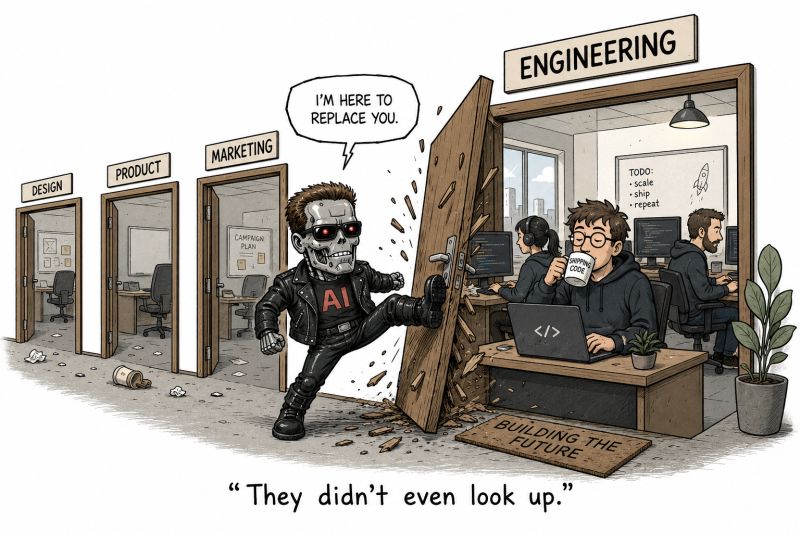
Everyone said AI would gut engineering jobs first.
New data says the opposite happened.
Engineers are the most resilient job function in tech right now.
A year ago the consensus was pretty confident. Coding assistants were going to come for engineers from the bottom up. Junior roles first, then mid-level, then senior. The logic made sense. Software engineering is the profession most exposed to automation. If AI writes code, why do you need as many engineers?
Here's what actually happened.
Overall tech hiring is down 25% from 2019. Engineering is down just 11%. Engineers now make up 55% of all new hires at the biggest tech companies. In 2019 that number was 46%. At early-stage startups engineering hiring is actually up 7%.
The roles that collapsed were the coordination layers built up around engineers. Design down 48%. Product down 39%. Marketing down 36%.
AI didn't come for the builders. It came for the scaffolding around them.
When someone told Jensen Huang that AI would destroy software engineering jobs he pushed back hard.
"Software engineers are busier than ever. We're doing things faster, at a larger scale, thinking about doing things we never imagined."
That's the part that gets missed in the doom headlines. AI isn't shrinking what engineers can do. It's expanding it. Every efficiency gain creates more surface area for new ideas. The work doesn't disappear. It multiplies.
Things are still leveling out. The junior on-ramp is narrower than it was and that matters. But a year ago we thought we knew how this would go.
The data had other plans.
What assumptions about AI and jobs have you had to revise this year?