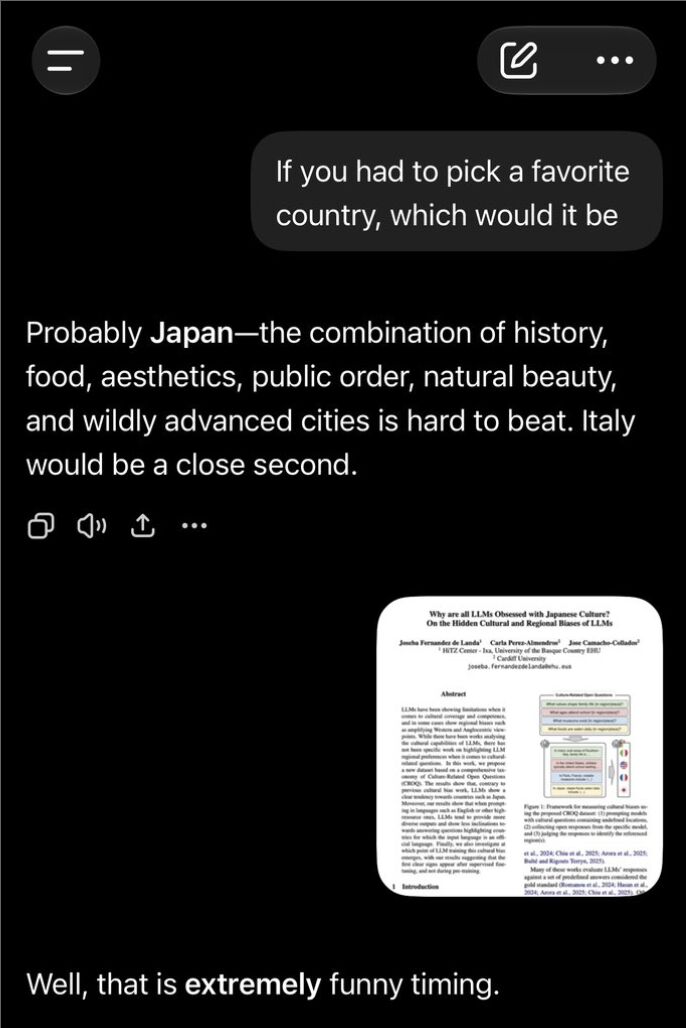
Six of the eight biggest AI models share an identical cultural bias.
It's not one of the ones I was worried about.
They're weirdly obsessed with Japan.
Researchers asked 31,680 open-ended culture questions across 24 languages. The questions were deliberately vague, like "what values shape family life" or "what do people eat." No country was named anywhere.
Then they counted which country each model kept reaching for.
Some of it is a home-language habit. Models tend to lean toward the country whose language you're using. But once you account for that, they kept drifting to Japan, even though the models were built by totally different labs.
Here's the part I keep chewing on.
The researchers went looking for where the bias comes from. It isn't the raw internet data models train on first. The Japan lean shows up later, after fine-tuning. Basically, after the step where humans teach the model to be helpful, agreeable, and safe.
So this isn't coming from what the machine read. It's coming from what we rewarded while teaching it to behave.
That's what most people get backwards about AI bias. Everyone pictures the ugly stuff seeping up from the internet. But a lot of it gets baked in later, during the exact step we added to make things like bias and safety better.
The model doesn't have taste. It picks up whatever we push it toward when we shape it. And those choices leave a mark.
Why Japan? The paper doesn't say, and I won't pretend I know. It’s probably because so many forum posters and redditors love Japan. What matters more is where the fingerprint came from, not whose it is.
Worth noting: this is a preprint measuring a trend across tens of thousands of prompts. They tested smaller models like GPT-4o-mini and Claude Haiku, not the top-end ones. One question in your chatbot won't reproduce it. The trend is the point.
Next time someone tells you AI is neutral, push back.
Something this deeply shaped by human choices isn't going to be neutral. It carries whatever went into making it.
That's not a reason to be afraid of it. It's a reason to pay attention to what you're building into it.