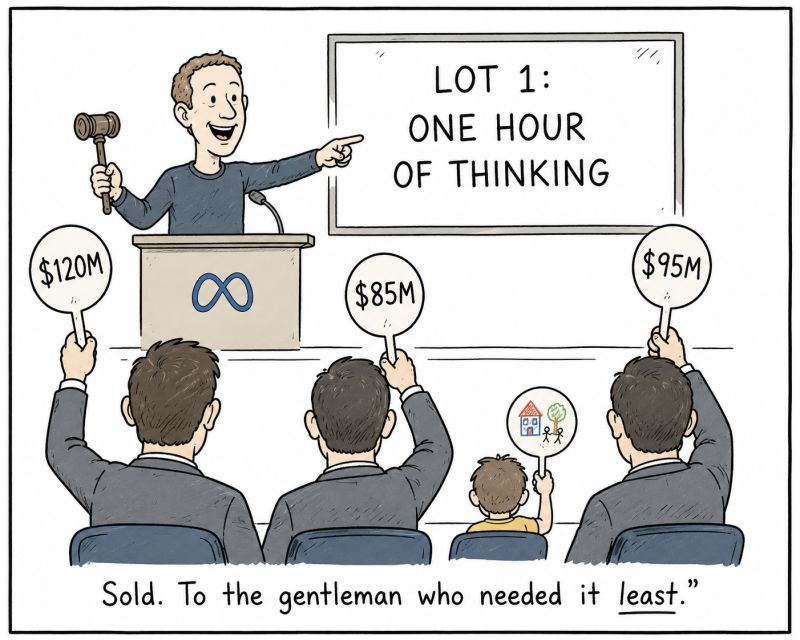
"A dynamic auction mechanism."
That's how Mark Zuckerberg described the way you'll pay for AI, in his new manifesto.
Translated: surge pricing. For thinking.
The idea is that people who want more compute bid for it, and capacity flows to whatever the market finds most valuable. He says it guarantees everyone the lowest price possible.
Here's the problem, and it's sitting in the same essay.
A few pages earlier he promises every kid a personal tutor with a PhD in every subject. Specifically the kid whose parents can't afford one today.
Now put those two ideas in the same room.
That's not how an auction works. An auction finds whoever can pay the most and calls that value. So when capacity gets tight, the kid doing homework is bidding against a hedge fund with a deadline.
Guess who gets outbid.
To be fair, the free tier is the good half of that essay. Free access for billions is a real commitment, and access genuinely is the problem worth solving. I'd also bet he isn't literally planning to price tokens by auction. It reads more like a man describing a market than announcing a product.
Which is what makes it revealing.
When you sketch the future off the cuff, you reach for the mechanism you actually believe in. He reached for an auction.
I've written a lot this year about intelligence getting metered. A meter is one thing. This is a meter whose number moves depending on who else wants it at the same moment.
The promise was that everyone gets a tutor.
The mechanism decides who gets one first.
When AI capacity gets scarce, and it will, who should get priority?